
Tumwater Previous Residents by Era
A backward address search works best when each source has a clear role. Current parcel tools identify the parcel and legal description. Recorded instruments name parties to land transactions. Older directories offer dated household clues, while census schedules show households at ten-year intervals. Archives add tax rolls, assessor cards, plats, and early deeds. None is a complete list of previous residents, but together they can show when a name first appears, when it disappears, and whether the person was an owner, a listed householder, or someone named for another reason.
| Source | Years It Covers | Where Held | What It Shows |
|---|---|---|---|
| Auditor deed index | Current index; archive deeds 1852-1979 | Thurston County Auditor and Southwest Archives | Grantors, grantees, recording dates, AFNs, and legal descriptions |
| County directories | Selected years, 1882-2005 | Washington State Library | Dated names, addresses, occupations, and household notes |
| Federal and territorial census | Public federal schedules through 1950; Thurston census from 1871 | NARA, TRL databases, and Digital Archives | Household members, ages, relationships, and enumeration place |
| Property and tax archives | Property records 1870-1967; tax material 1894-1965 | Southwest Regional Archives | Ownership, assessments, parcel facts, and tax context |
| Tumwater permits | Dates depend on the permit record | City Eden search and Community Development | Project, applicant role, parcel, dates, status, and inspections |
For a recent chain, start with the Thurston A+ parcel search and the Auditor index. For a nineteenth or early twentieth-century trail, expect an archive or library step. The county-directory list has gaps, and the research did not confirm a local reverse-directory run, so do not promise an address-first volume for every year. Record each missing year as a gap rather than bridging it with a guess.
Turn Tumwater Deeds Backward
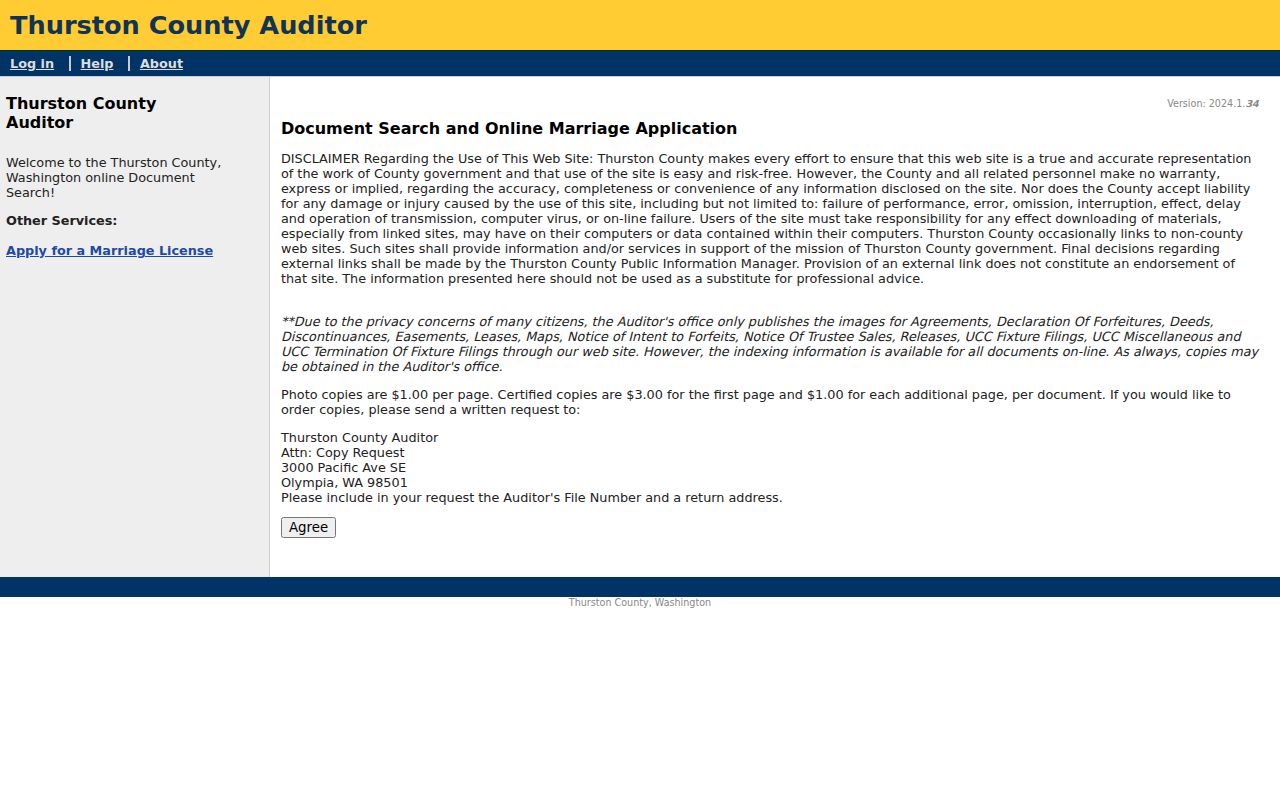
The Thurston County Auditor EagleWeb index is the key bridge from today's parcel to past owners. An Auditor's File Number, or AFN, identifies a recorded instrument. The index can show the document type, recording date, grantor, grantee, and legal-description clues. Online images exist only for specified document classes. When an image is not offered, use the AFN in a written copy request or contact Recording Services at 360-786-5405 or recording@co.thurston.wa.us.
The index itself is public. Plain copies cost $1 per page. A certified copy costs $3 for the first page and $1 for each added page. Certification proves the copy came from the recording office, not that every statement in the instrument is true. The Auditor records documents in a ministerial role and does not decide title disputes.
The captured EagleWeb search screen shows the official gateway used to begin a Tumwater previous residents deed search.
Save the AFN and record date before leaving the result. Those two fields make an office copy request far more precise.
Trace Thurston County Past Owners
A chain of title is the linked series of recorded transfers for one parcel. Begin with the current parcel report, but treat the owner display as dated information rather than proof of who now lives there. The legal description is more durable than a street address. It identifies land by lot, block, plat, or another formal description and helps separate parcels when names repeat or streets change.
- Find the address in the county map or A+ search. Save the parcel number, situs address, legal description, city flag, and report date.
- Search the displayed owner's purchase deed in EagleWeb. Confirm the parcel or legal description before accepting the match.
- Read the seller as grantor on that deed. Search that seller as a grantee to locate the deed by which the seller acquired the same land.
- Repeat the transfer chain, logging every AFN, date, party role, and document type. Flag breaks rather than assuming two similar names are one person.
- For earlier records, contact the Auditor or Southwest Archives and use deed books, indexes, title registers, and archived property material.
- Grantor
- The party transferring an interest, often the seller in a deed.
- Grantee
- The party receiving an interest, often the buyer.
- Chain of title
- The sequence of recorded transfers for the same land.
- Legal description
- The formal land description that stays useful when an address label changes.
Tumwater Address Records Before Portals
The Southwest Regional Archives holdings abstract extends a Tumwater address search well past the live web portals. It lists Thurston deeds from 1852 to 1979, title abstracts and registers from 1853 to 1982, property records from 1870 to 1967, homestead, patent, and donation indexes from 1869 to 1904, and maps, plats, and surveys from 1890 to 1994. Assessor rolls and photographic property cards can add assessed structures and dates. Treasurer tax documentation covers 1894 to 1965.
The branch is at 1120 Washington Street SE in Olympia and can be reached at 360-753-1684 or swbrancharchives@sos.wa.gov. Ask for the county, agency, series, date span, name, and parcel or legal description. An archive reference is strongest when it records the exact series, volume or accession, page, and date. A broad surname hit without a tract or parcel tie is weak evidence of previous residents.
One local quirk makes the archive unusually rich. The abstract also lists Tumwater City Clerk minutes from 1869 to 1936, an 1859-1860 Crosby Warehouse ledger, an 1892 Frank Stevens journal, and an 1854 survey map. These sources can place names in New Market or the brewery landscape, but they describe civic and commercial roles, not automatic residence.
Map a Tumwater House Through Time
Maps and permits explain changes that a deed alone may not show. The Tumwater Eden permit search accepts permit number, project name, applicant last name, customer number, dates, permit type, street or parcel address, suite, status, map number, lot, subdivision, and parcel number. A permit can date a remodel, addition, demolition, or relocation. Yet an applicant may be an owner, contractor, or agent, so the name is not proof of occupancy.
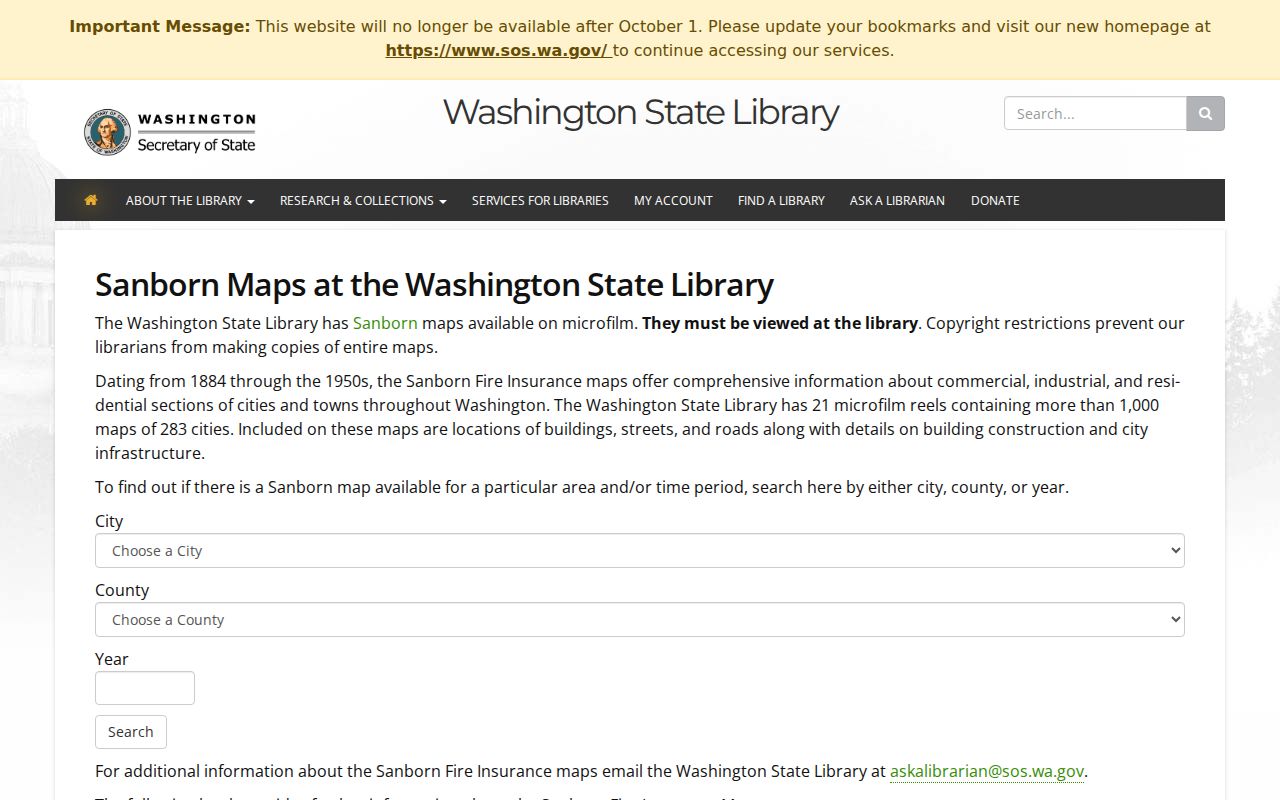
The State Library Sanborn collection holds more than 1,000 maps for 283 Washington towns on 21 reels, dating from 1884 through the 1950s. Search controls include city, county, and year. Exact Tumwater reel years were not confirmed in the accessible catalog. Maps are viewed at the library, and entire-map copying is barred by the stated copyright rule.
The captured Sanborn search page illustrates the city, county, and year route used to test a historic Tumwater address.
A Sanborn sheet can show a structure, use, street label, and block geometry for a chosen year. Pair it with a deed, directory, or census record before attaching a household name.
Check Tumwater Address Continuity
Before concluding that past residents vanished, test the address itself. Tumwater's addressing rules put SW suffixes west of Capitol Boulevard and SE suffixes east of it. East-west routes are generally Avenues, north-south routes Streets, and diagonal routes Drives. Places, Ways, Courts, Loops, and Lanes have their own local conventions. Preserve the wording printed in the old source, then search the normalized form as a second query.
No official citywide street-renumbering year was found. That gap matters. Do not assign a modern number to an old household without a plat, map, directory key, or other source. Annexations also changed municipal context in 2018 at Littlerock Road, 806 Yelm Highway, and Sapp Road. ZIP codes did not change merely because the city boundary changed.
Address check. Treat Capitol Boulevard and old Highway 99 as historical search variants, especially around the brewery corridor altered by I-5 construction in 1959.
Tumwater Cemetery Dates Close Gaps
Union Pioneer Calvary Cemetery can supply an end date when a former household member disappears from deeds or directories. The city cemetery history describes marked interments from 1855, the Union cemetery's 1866 or 1867 origin, the Pioneer Calvary origin in 1873, and a new section opened in 1909. The site entered the National Register in 1997.
A marker or burial record can confirm a name and date, but it does not prove the person occupied a specific Tumwater house. Compare it with a directory entry, census household, obituary, probate file, or deed. Keep restoration dates separate from historical death dates: volunteers cleaned the cemetery in 2019, and 221 markers were restored in 2024 and 2025.
Tumwater Past Households in Print
Ownership is only one layer. A deed may name an estate, trust, or absent owner, while a directory may list a householder at the street address for that publication year. The State Library lists selected Thurston County directory years from 1882 through 2005. Its catalog names R.L. Polk's Olympia, Washington, city directory, including Lacey and Tumwater. Full collection details belong on the Tumwater city directory page; for address history, extract only the printed name, address, role or occupation, year, page, and any change from the prior edition.
Pair directory years with census years instead of assuming continuity. Start with a directory name and exact printed address. Find the nearest public census schedule, then check household members, relationships, ages, and enumeration geography. Return to the next available directory edition and log each change. The 1871 Thurston territorial and state census collection is an earlier option, while federal census schedules are public through 1950 under the 72-year release rule.
- Transcribe the directory entry exactly, including suffixes and abbreviations.
- Match the nearest census by name, place, age, and household, not by surname alone.
- Check the deed or assessment role for the same date range.
- Use newspapers, an obituary, probate docket, or cemetery record to explain a departure or death.
Timberland Regional Library offers HeritageQuest, in-library Ancestry Library Edition, Northwest Digital Heritage, newspapers, and staff referrals. The State Library closed to general public access in 2025 and offers limited Thursday appointments, so verify access before visiting. A distinct official Tumwater reverse-directory or obituary-index title was not confirmed.
Lawful use. Research previous residents for family history, estate work, or a Tumwater house history. Never use an old or current address to track, harass, or harm a living person.